
Activewear MOQ Explained: Per Style, Color, Size or Set?
By YogaSewReviewed by ChengLei Shao
· Updated
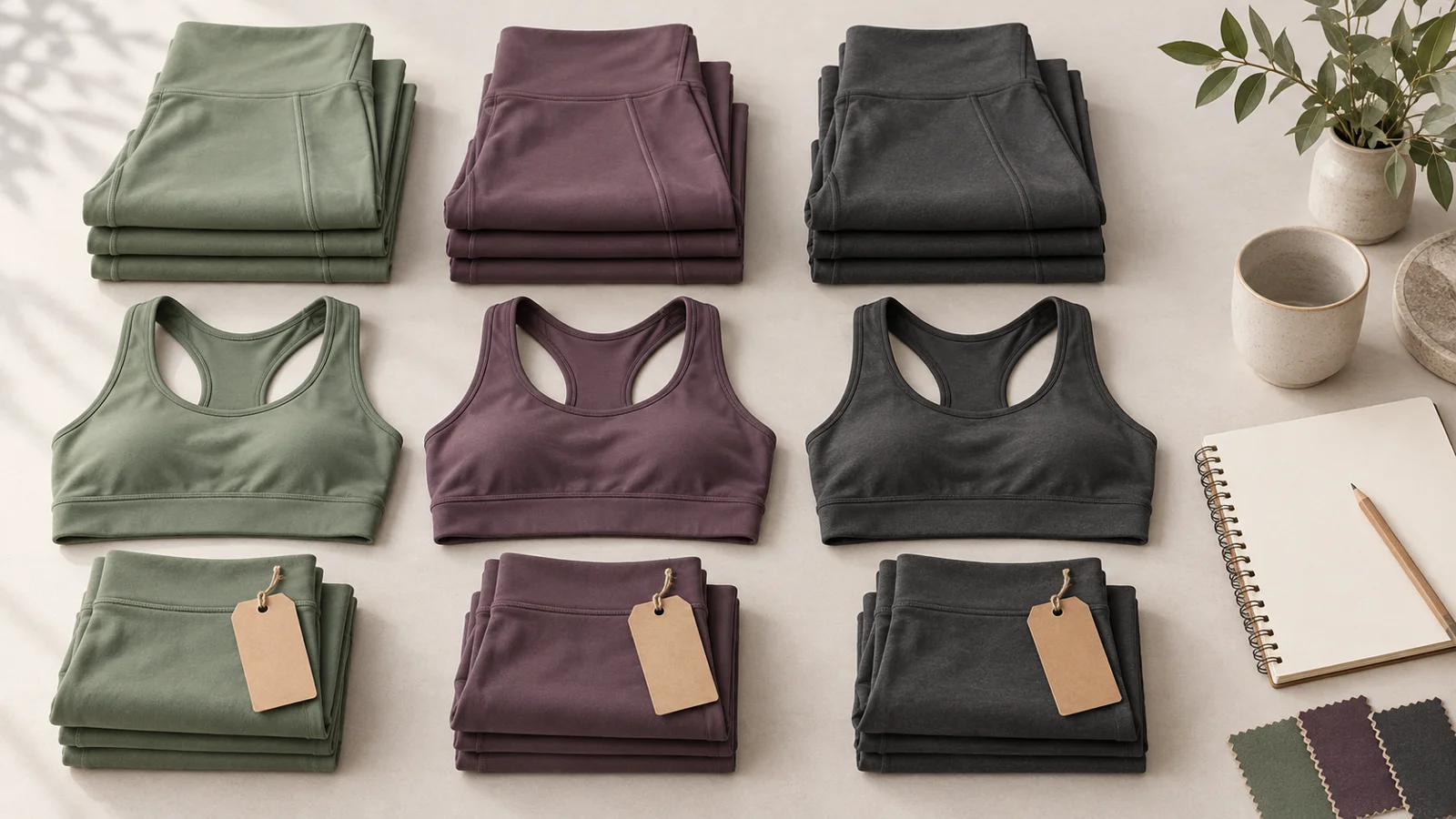
Cover: AI-generated assortment illustration, not a representation of available stock.
An activewear MOQ is useful only when the quotation defines what is being counted. “Per order,” “per style,” “per color” and “per size” describe different conditions. For matching sets, you also need to know whether the unit is a complete set or an individual garment.
Before comparing factories, turn your collection into a quantity table. Give each style its colors and size breakdown, then ask the supplier to mark which minimum applies to each part. This is more useful than sending a total quantity and assuming it can be divided in any way.
YogaSew applies its minimum per style and color, with mixed sizing and a separate complete-set counting unit. Our low-MOQ page gives the current quantities and ordering terms. The examples in this guide explain how to read a quotation; none of their numbers is a YogaSew minimum, price offer or availability promise.
Key takeaways
- Ask the supplier to state the counting unit and every applicable minimum.
- A size breakdown divides a color total unless a separate per-size minimum also applies.
- Fabric, decoration, labels and packaging can have their own purchasing conditions.
- Clarify whether a yoga set means one saleable set or two individual garments.
Define each MOQ condition in plain language
A minimum order quantity is the lowest quantity accepted under the stated commercial conditions. The word “minimum” does not tell you whether the condition applies to the whole order or a particular style/color combination.
Use this translation table when reading a proposal, then have the supplier confirm the meaning in writing.
| Wording in a quote | Question it should answer |
|---|---|
| Minimum per order | How many units must the complete purchase contain? |
| Minimum per style | How many units of each distinct design are required? |
| Minimum per style/color | How many units of one design in one color are required? |
| Minimum per size | Is there a minimum in each size within a style/color? |
| Minimum per set | Which garments make one set, and can their sizes differ? |
| Material or component minimum | What must be purchased separately from the finished garments? |
Several conditions can apply at once. Meeting a total-order minimum does not automatically satisfy a per-color condition. Equally, a per-color minimum does not automatically mean the same number is required in every size.
For custom yoga wear, include enough design information to identify what you consider one style. Ask whether a change in length, pocket layout or other construction detail will be quoted as a different style rather than deciding that from the shared collection name.
Work through a hypothetical order
Suppose a quotation requires 150 garments per style/color, permits the size allocation below and has no additional per-size minimum. You plan two styles, each in two colors. Those assumptions produce four style/color groups and a total of 600 garments.
This is invented arithmetic for explanation only. It is not a supplier offer or a recommended first-order size ratio.
| Style and color | XS | S | M | L | XL | Garments |
|---|---|---|---|---|---|---|
| Legging A, black | 20 | 40 | 50 | 30 | 10 | 150 |
| Legging A, sage | 20 | 40 | 50 | 30 | 10 | 150 |
| Bra B, black | 20 | 40 | 50 | 30 | 10 | 150 |
| Bra B, sage | 20 | 40 | 50 | 30 | 10 | 150 |
| Total | 80 | 160 | 200 | 120 | 40 | 600 |
The size columns allocate each 150-piece color total. They do not multiply that minimum by five. If the supplier adds a separate minimum per size, check every cell against that requirement and revise the distribution where necessary.
Techpacker's quantity-breakdown documentation uses a color-and-size matrix to support MOQ review and early costing. You can apply the same basic structure in a spreadsheet without using a particular software product.
An equal split between colors is not a demand forecast. Build the commercial allocation from your own sales plan, then ask the supplier which parts are feasible. Keep the buyer's preferred quantities separate from the manufacturer's confirmed conditions.
Count matching sets explicitly
In the example above, 600 individual garments contain 300 leggings and 300 bras. If the pairs are compatible in color and the agreed sizing arrangement, they could form 300 two-piece sets. That is different from ordering 600 sets, which would require 1,200 individual garments.
Write both counts in the inquiry when ambiguity is possible: “300 two-piece sets, comprising 300 bras and 300 leggings.” Then provide the size allocation for each component. If customers can choose different top and bottom sizes, show those requirements separately instead of assuming identical size ratios.
Ask whether the supplier quotes and packs by set or by garment. A style/color minimum on each component can still matter even when the products will be sold together. Confirm how extra tops, extra bottoms and later replenishment would be handled before treating the set as one indivisible ordering unit.
Separate garment minimums from material commitments
A garment quantity does not necessarily settle every material and branding purchase. Ask whether the proposed fabric, custom color, logo, label or packaging has an independent minimum or setup charge.
For a primary example of that distinction, trim and packaging supplier Weavabel's FAQ publishes different minimum-order conditions for labels/badges, packaging and garment bags. Those are Weavabel's own terms, not YogaSew's. The useful buying principle is to ask for each component's condition rather than applying the garment number to everything.
Use a short list of separate questions:
- Fabric and color: is the proposal based on an existing material option or a custom material/color commitment?
- Logo and labels: what quantity, artwork or setup condition applies to each item?
- Packaging: is standard packing included, and does custom packaging have a separate purchase requirement?
- Unused materials: if a component order exceeds the garment order, who pays for and owns the balance?
- Storage and reuse: can the balance be held, for how long, and under what agreed conditions?
The fabric buying guide can help you define the material being quoted. For branding, the logo-method comparison explains why process, dimensions and placement should be settled alongside artwork.
Ask what can change in a smaller first order
Present your preferred order plan, then ask which change would make the proposal workable. Possible discussion points include fewer colorways, a shared fabric across suitable styles, fewer custom components or a different material option. Each is a question for review, not a guaranteed way to reduce the minimum.
For example, if you want four colors but the quoted color condition exceeds your budget, ask for a comparison between the original plan and a two-color plan. Request the revised unit price, total commitment and specification assumptions together. A lower garment count is not automatically a lower overall purchase if other charges or component commitments change.
For private-label development, ask which parts of an existing pattern can be retained and which requested changes alter the quotation. Do not assume “private label” means ready stock, unlimited mixed sizes or an automatic low minimum.
Keep samples and reorders separate from bulk MOQ
A sample request and a bulk purchase solve different tasks. Ask about sample development, charges and approval steps separately from the intended bulk quantity. The ability to make a sample does not establish the commercial minimum for a later production run.
Reorders also need their own confirmation. Ask whether the same style can be repeated, which materials remain available, and whether the color or component conditions still apply. Record what is confirmed now and what must be reviewed again when the reorder is placed.
Add the final quantity breakdown to your current tech pack or ordering brief, alongside the style and material references. A quantity table linked to an outdated design can create just as much confusion as a missing size column.
FAQ
Can I mix sizes within an activewear MOQ?
YogaSew allows mixed sizing within a style/color quantity; see the current size allowance. When comparing other suppliers, confirm their permitted allocation and any per-size minimum rather than assuming the same rules apply.
Can I combine several styles to meet one minimum?
At YogaSew, each style in each color must meet its own minimum. Combining different styles or colors does not satisfy that minimum. Other suppliers can use different conditions, so compare their quantity breakdowns explicitly.
Does adding my logo change the minimum?
At YogaSew, logos, labels and packaging do not add a separate minimum quantity. Include the artwork and packing requirements in the quote brief. Other suppliers can apply separate component minimums or setup charges; a minimum quantity and a price inclusion are different conditions.
What is YogaSew's minimum order quantity?
YogaSew applies its minimum per style, per color to both cut-and-sew and seamless styles. Matching top-and-bottom outfits are counted as complete sets. See the current garment and set minimums, mixed sizing and branding terms. Send your design, color and size breakdown for a project quote.
Send a quantity plan that can be reviewed
Send your yoga-wear order plan to YogaSew with the following information:
Styles: reference images or current design/tech-pack revisions.
Units: individual garments or clearly defined sets.
Breakdown: quantity by style, color and size.
Materials and branding: selected references or the choices still open.
Priority: the total commitment you want reviewed and which design or color choices are flexible.
Use the published YogaSew ordering terms to build your quantity plan. Your design, materials and branding then define the project quotation and development schedule.
Written by YogaSew, the yoga wear manufacturing brand of Dongguan Jiashun Clothing Co., Ltd.. Sources checked on October 10, 2026. All order quantities in the worked example are hypothetical and do not represent YogaSew commercial terms.
About the reviewer
ChengLei Shao is the Brand Manager at YogaSew. ChengLei reviews the brand’s articles before publication.