
Nylon vs Polyester for Yoga Wear: A Brand Buyer's Fabric Guide
By YogaSewReviewed by ChengLei Shao
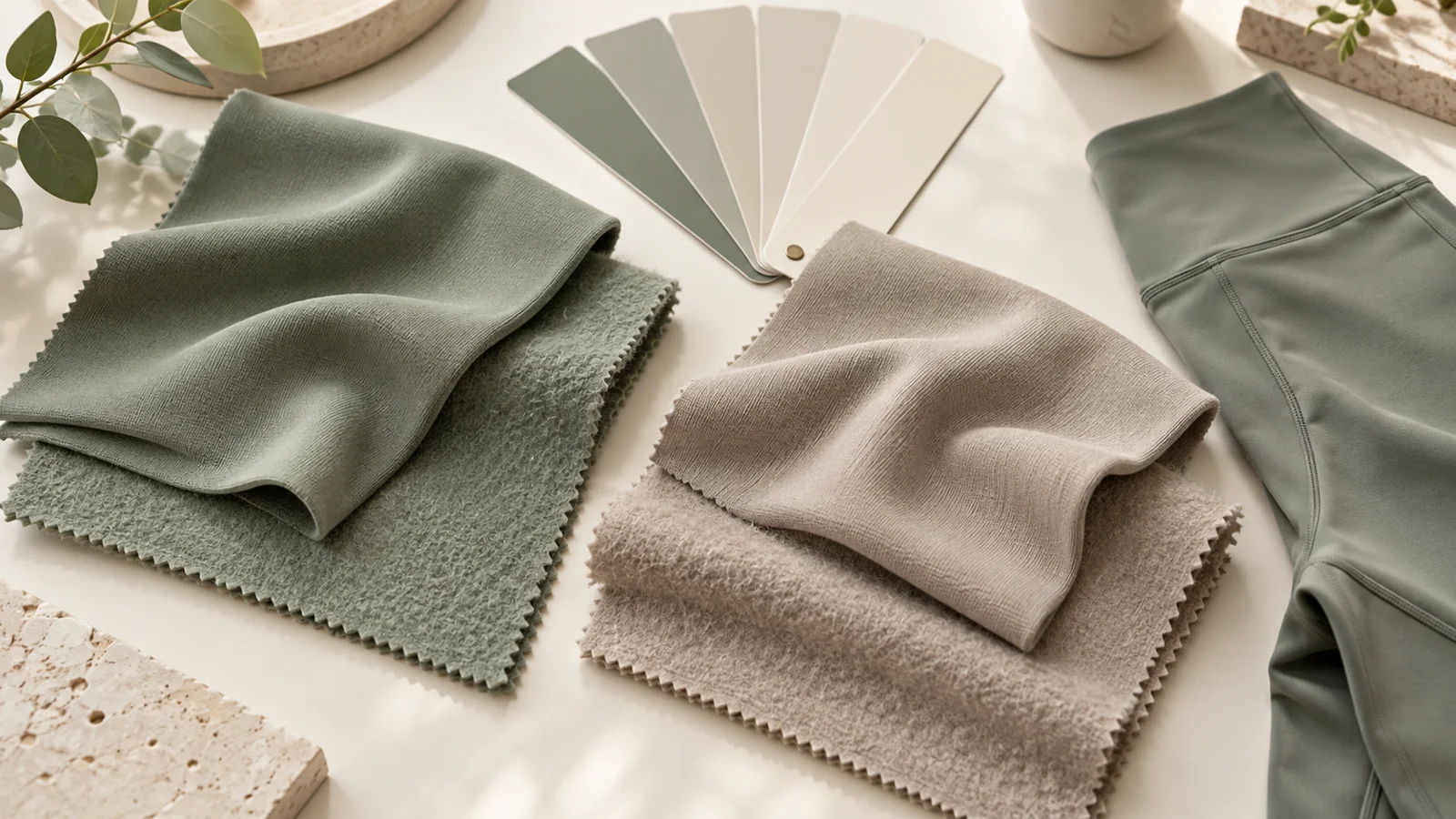
Cover: AI-generated fabric illustration. The pictured textures do not identify fiber composition.
For a yoga brand, the useful comparison is between two specified fabrics, not just the words nylon and polyester. Request samples with their blend, construction, weight and finish identified. Then compare them against the same intended garment, activity and care requirements.
Both fiber families appear in stretch apparel, including blends with elastane. But a composition label is only part of the buying decision. It does not tell you how a legging will fit, whether a chosen color provides the coverage you want, or how a particular logo will behave on its surface.
Use this guide to prepare a yoga-wear fabric discussion. The aim is to select and document a candidate for development, with the remaining questions made explicit.
Key takeaways
- Compare complete fabric references, including construction and finish, alongside composition.
- Ask separately about stretch, recovery, drying, coverage and care; one claim does not answer all five.
- Print and logo requirements can narrow the suitable material choices.
- Approve the material in the intended garment before treating a swatch preference as a production decision.
What nylon, polyester and elastane tell you
Nylon and polyester identify fiber families. Elastane, also called spandex, is a separate component used for stretch. The LYCRA Company explains that its branded elastane fiber can be combined with other fibers, including nylon and polyester.
Keep the generic fiber name separate from a trademark. A fabric described as containing spandex is not automatically made with LYCRA-branded fiber. If a branded input is part of your product brief, ask for confirmation of that exact material rather than using the name as shorthand for every stretch blend.
For either a nylon/elastane or polyester/elastane candidate, request the complete fabric article reference. Record the stated composition, knit or other construction, finished weight, width where relevant, color and surface finish. This gives sample comments a fixed subject: “candidate N, brushed finish, color A” is more useful than “the nylon one.”
Compare candidates using the same questions
There is no useful universal winner for softness, support, drying or value without defining the fabrics and conditions being compared. Instead, use the same review sheet for both candidates and let the observed or tested result guide the choice.
| Buying decision | Ask for the nylon candidate | Ask for the polyester candidate |
|---|---|---|
| Handle and surface | The actual finished swatch and finish reference | The actual finished swatch and finish reference |
| Stretch and recovery | Fabric-level evidence relevant to the intended fit | Fabric-level evidence relevant to the intended fit |
| Coverage | A garment review in the intended color, size and fit | A garment review in the intended color, size and fit |
| Moisture claims | The property tested and the report conditions | The property tested and the report conditions |
| Decoration | A compatible logo or print proposal | A compatible logo or print proposal; discuss sublimation if needed |
| Commercial fit | Current availability, color minimums and quoted specification | Current availability, color minimums and quoted specification |
This table is a buying worksheet, not a laboratory comparison. It deliberately leaves the result open until the two fabrics have been identified. If the candidates differ in weight, finish or construction, record that difference rather than attributing every observation to the base fiber.
Choose the feel you want, then keep its specification
Describe handfeel with a physical reference and plain language: smooth or brushed, dry or slick, light or substantial. Ask the developer to identify which candidate is closest and what else changes with that choice. “Buttery soft” can express a direction, but it is not enough to reorder the same fabric reliably.
For a hypothetical studio-yoga legging, you might prefer candidate N's surface but find candidate P closer to the desired weight. That is a useful result to discuss. It does not justify a general statement that all nylon is softer or all polyester is lighter. Keep both article references and ask whether an alternative construction or finish would address the remaining requirement.
The role of fabric engineering is visible in suppliers' own technology descriptions. Cotton Incorporated's TransDRY guidance identifies formulation, construction and finishing as variables affecting drying in that particular cotton technology. It is not a nylon-versus-polyester trial; it illustrates why a fiber name alone is an incomplete specification.
Separate stretch, recovery and support
Ask how the finished fabric stretches and returns, and what evidence is relevant to your intended use. An elastane percentage is composition information, not a complete description of the garment's fit or pressure on the body.
The LYCRA Company's SPORT fabric program evaluates characteristics at fabric level, including stretch, recovery and compression. That is a useful example of how performance can be assessed beyond a fiber label. It does not mean your project requires that branded program or that YogaSew supplies a certified fabric.
For your own development, state the wearer experience you are trying to achieve, then review it with the pattern and fabric together. For example, “a secure waistband for studio movement without a restrictive feel” is a design intention. The sample still needs review before you describe its support to customers.
If you change the fabric after approving fit, ask which measurements and movement checks need repeating. The seamless and cut-and-sew comparison also explains why construction choice belongs in this discussion.
Treat drying and coverage as separate questions
“Moisture management” is too broad to act as one pass/fail requirement. AATCC's standards index lists distinct methods for properties such as absorbency, drying rate and water-vapor transmission. Those are different questions, even when a fabric supplier groups them under one marketing description.
If quick drying matters to your collection, ask what was tested, on which fabric and under which conditions. Agree the relevant method and acceptance requirement with the testing specialist. Do not copy a result from another article reference or assume the same claim follows from a similar fiber blend.
For coverage, use a separate garment review record. Identify color, size, wearer fit, movement and viewing conditions. A swatch held in the hand and a fitted legging are different review situations. Keep an internal observation such as “no visible show-through in this agreed check” separate from a broad product guarantee.
Neither a GSM number (fabric weight in grams per square metre) nor a nylon/polyester label should close that decision by itself. Record what the particular sample demonstrated and what still needs assessment.
For care, agree the wash and drying conditions before comparing the two candidates. Record garment dimensions, surface appearance, color and fit before and after the agreed review. Keep the conditions and sample references with the result. A home wash observation is not a standardized laboratory report; where a claim needs formal evidence, ask a specialist to select a suitable method rather than inventing a wash-cycle count or pass limit.
Bring printing and branding into the fabric decision
If an all-over sublimation print is central to the design, tell the developer before choosing the fabric. Epson's sublimation guidance identifies polyester fabrics as substrates for its process. A suitable polyester-based candidate is therefore a practical starting point for that conversation, with the blend and exact printing process still to be confirmed.
That does not mean nylon cannot be decorated, or that every polyester/elastane fabric accepts the same application settings. A small logo and an all-over print can require different decisions. Ask the decorator to review the actual fabric, finish, color and artwork.
Our activewear logo guide explains how to compare flat transfers, silicone details and embroidery. Bring the selected decoration into the sample stage so material approval does not leave branding compatibility unresolved.
Compare quotes for the same fabric brief
Request prices against the specific article, color plan and intended order breakdown. A cheap quote for an undefined “nylon blend” is difficult to compare with a quote that includes a named finish, custom color and testing requirement.
Record what each proposal includes and which decisions remain open. Ask about material availability, color minimums, sampling and repeat-order arrangements. The MOQ guide helps separate the finished-garment quantity from any fabric or component commitment.
Before moving into sample development, add the chosen reference to your tech pack. Keep an approved physical swatch or agreed reference, along with the relevant specification and review notes. If a substitute is proposed later, compare it explicitly rather than keeping the old material name in the document.
FAQ
Is nylon or polyester better for yoga leggings?
Choose the specified fabric that meets the style's fit, feel, coverage, decoration and care requirements. Compare actual candidates under the same conditions. A fiber-family preference can start the search, but it is not enough to approve the finished garment.
Does more elastane mean better leggings?
The percentage tells you the stated blend. It does not, on its own, establish fit, comfort or recovery in the intended garment. Ask for fabric-level information and review the sample against the wearer's needs.
Should I choose polyester for a sublimation print?
Discuss a suitable polyester-based fabric with the printer when conventional dye sublimation is part of the design. Confirm the actual blend, color and process before approval. This is a printing compatibility question, not a verdict on every other property of the fabric.
Can I substitute a similar blend after approving the sample?
Treat it as a material change. Ask what differs in construction, finish, weight and performance evidence, then agree which sample checks need repeating. Matching composition percentages do not establish that two fabric references are interchangeable.
Prepare your fabric brief for YogaSew
Send YogaSew your fabric reference and intended style, with the desired feel, color direction, decoration and order plan. Include the trade-off you want help resolving. Material suitability, minimums and timing are confirmed after specification review.
Written by YogaSew, the yoga wear manufacturing brand of Dongguan Jiashun Clothing Co., Ltd.. Sources checked on October 10, 2026. This is a research-based buying guide, not a comparative laboratory test or a claim that YogaSew supplies the branded technologies cited.
About the reviewer
ChengLei Shao is the Brand Manager at YogaSew. ChengLei reviews the brand’s articles before publication.